 Cardiology
 Cardiovascular Thoracic Surgery
 Endocrinology
 Neurology
 Neuro Surgery
 Nephrology
 Urology
 Gastroenterology
 Pulmonology
  Plastic Surgery
 Nuclear Medicine
  Anesthesiology
  Transfusion Medicine
  Medical Oncology
  Surgical Oncology
  Radiation Oncology
  Critical Care Medicine
  ENT
ENT General Medicine
 General Surgery
 Gynaecology & Obstetrics
 Ophthalmology
 Orthopaedics
 Paediatrics and Neonatology
  Spine Surgery
 Cathlab
 MRI
(3.0 Tesla)
MRI
(3.0 Tesla) CT
Scan (128 Slice)
CT
Scan (128 Slice) 2D Echo
 TMT
TMT PFT
PFT EEG
EEG EMG
& NCS
EMG
& NCS Audiometry
 Flexible Laryngoscopy
 Endoscopy
& Colonoscopy
Endoscopy
& Colonoscopy Bronchoscopy
 Allergy Testing (Skin Prick Test-SPT)
 Microbiology
 Pathology
 Radio-diagnosis
 Radiation Therapy
 Physiotherapy
 Radiology
 Pharmacy
 AKU
Dialysis
AKU
Dialysis  Emergency Service
 Executive
Health Checkup
Executive
Health CheckupDr. Dhiraj Agarwal
MBBS, MS
General Surgeon


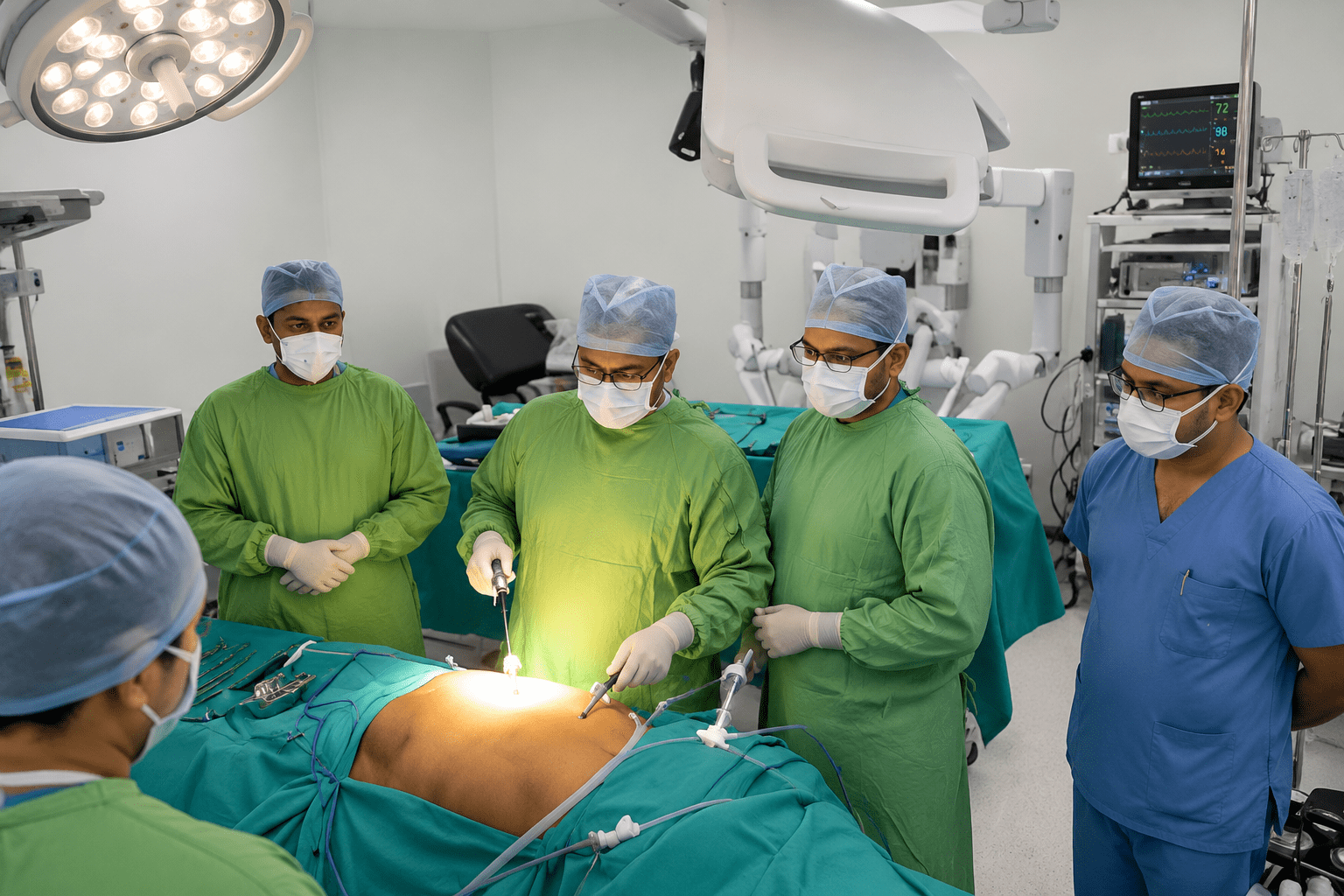
A hernia occurs when an organ or tissue pushes through a weak area in the surrounding muscle or abdominal wall. It may appear as a lump or swelling and can cause pain, heaviness or discomfort, particularly while coughing, lifting or standing.
Laparoscopic hernia surgery is a minimally invasive technique used to repair certain types of hernias through small abdominal incisions. Compared with conventional open surgery, it may offer smaller incisions, less visible scarring and a potentially faster recovery in appropriately selected patients.
At Bombay Hospital Jaipur, the Department of Laparoscopic General and GI Surgery provides treatment for hernias, including inguinal, umbilical and incisional hernias. The department offers laparoscopic surgical care supported by advanced operating theatres, ICG laparoscopic technology, diagnostic facilities and postoperative monitoring.
A hernia develops when tissue pushes through a weakened area of muscle or connective tissue. Hernias commonly occur in the abdominal wall and groin.
Common types include:
A hernia may initially cause little discomfort but can gradually become larger or more symptomatic.
Common symptoms include:
A swelling that suddenly becomes very painful, firm or difficult to push back may indicate a complication and requires urgent medical assessment.
Surgery may be recommended when a hernia:
Not every hernia requires immediate surgery. The surgeon evaluates the type, size, symptoms and individual health before recommending treatment.
Laparoscopic hernia surgery uses a small camera called a laparoscope and specialised surgical instruments inserted through small abdominal incisions.
The surgeon identifies the hernia, returns the protruding tissue to its appropriate position and repairs the weakened area. A surgical mesh may be used where appropriate to reinforce the abdominal wall and support the repair.
Bombay Hospital Jaipur's General Surgery department specifically provides laparoscopic surgery and treatment for inguinal, umbilical and incisional hernias.
For suitable patients, the minimally invasive approach may provide:
However, laparoscopic surgery is not automatically the best option for every hernia. The appropriate surgical approach depends on the hernia's location and size, previous surgeries, overall health and other clinical factors.
Before Surgery
Your surgeon reviews your symptoms, medical history and previous surgeries. A physical examination is performed, and imaging such as ultrasound or CT may be recommended when necessary.
Preoperative tests and anaesthesia assessment are also completed according to your individual needs.
During Surgery
The procedure is performed under appropriate anaesthesia.
Small incisions are made to introduce the laparoscope and surgical instruments. The surgeon carefully manages the hernia and reinforces the weakened abdominal wall, often using mesh when clinically appropriate.
After Surgery
You are monitored in the recovery area and receive appropriate pain management and postoperative instructions. Your discharge depends on the procedure and your recovery.
Recovery varies depending on the type and size of the hernia, surgical technique and overall health.
You may be advised to:
Your surgeon will provide specific guidance regarding exercise, driving, work and lifting.
The General Surgery department at Bombay Hospital Jaipur is equipped with:
The department also has a team of surgeons, gastroenterologists, anaesthetists and nursing professionals supporting laparoscopic and endoscopic procedures.
Bombay Hospital Jaipur provides laparoscopic general and GI surgical care within a tertiary-care hospital environment.
Patients have access to:
Dr. Dhiraj Agarwal is listed by Bombay Hospital Jaipur as a Consultant Laparoscopic General & GI Surgeon, with MS (Surgery), FIAGES, FMAS and FAIS qualifications and 20 years of experience.
Consult a surgeon if you notice:
Seek urgent medical attention if the swelling becomes suddenly painful, firm or irreducible, especially if accompanied by vomiting, abdominal swelling or fever.
Both techniques have a role. Laparoscopic surgery can offer smaller incisions and potentially faster recovery in suitable patients. The surgeon selects the approach based on the individual hernia and patient's health.
Mesh is commonly used in many hernia repairs to reinforce the weakened abdominal wall, but its use depends on the type and characteristics of the hernia.
The duration varies according to the type and complexity of the hernia. Your surgeon can provide an estimated procedure time after evaluation.
Recovery varies. Light movement is generally encouraged as advised, while heavy lifting and strenuous exercise should be resumed only after receiving clearance from your surgeon.
Recurrence is possible after hernia repair. Surgical technique, the type of hernia and individual patient factors can influence the risk.
If a hernia is causing pain, increasing in size or interfering with your daily activities, timely surgical evaluation can help determine the most appropriate treatment.
Consult the General Surgery team at Bombay Hospital Jaipur for personalised assessment and laparoscopic hernia treatment.
MBBS, MS
General Surgeon
 Book an Appointment