×


Kidney stones are hard deposits that form when certain minerals and salts in the urine become concentrated and crystallise inside the kidneys. They may remain small and pass naturally, but larger stones can block urine flow and cause severe pain or complications.
At Bombay Hospital Jaipur, kidney-related conditions are managed through the Nephrology and Urology departments. While nephrology provides comprehensive kidney care, the Urology department offers specialised stone-management procedures including flexible ureteroscopy, percutaneous nephrolithotomy (PCNL), lithotripsy and other surgical approaches, depending on the stone and patient's condition.
Kidney stones are solid crystals that develop when minerals and other substances in urine become concentrated.
A stone may remain in the kidney without causing symptoms. Problems can occur when it moves into the ureter—the tube connecting the kidney to the bladder—and obstructs the normal flow of urine.
Kidney stones can vary considerably in size, location and composition, so treatment is not the same for every patient.
Small stones may cause no symptoms. When a stone moves or blocks urine flow, symptoms can include:
Severe pain accompanied by fever, chills, difficulty passing urine or vomiting requires prompt medical attention.
Kidney stones can develop for several reasons. Factors that may increase the risk include:
A person who has had one stone may also be at increased risk of developing another, making prevention an important part of long-term care.
Diagnosis begins with a medical history and physical examination. Your doctor may recommend:
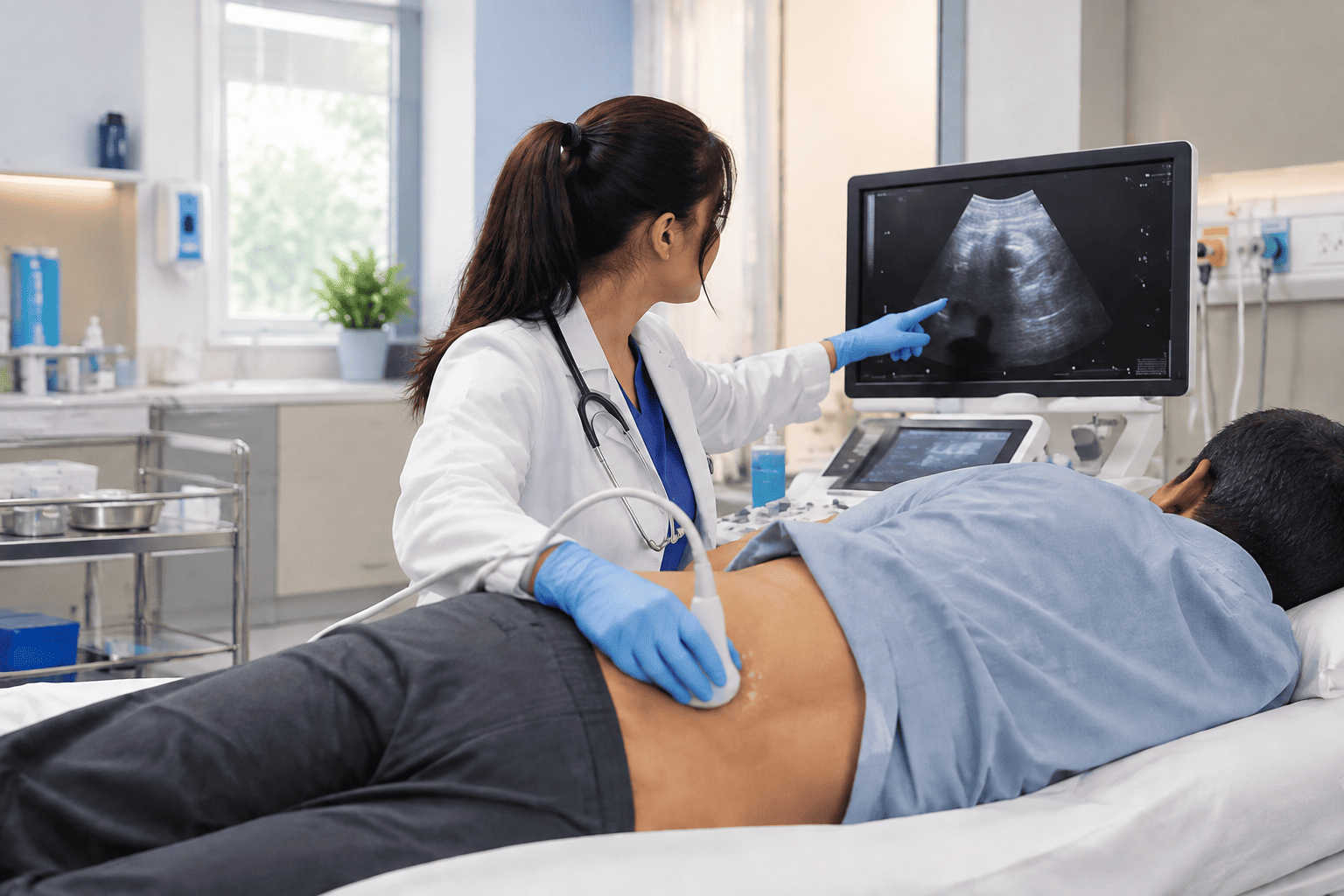
Imaging helps determine the size, number and location of stones and whether there is obstruction or another complication.
Bombay Hospital Jaipur has advanced radiology facilities including CT, MRI, X-ray and ultrasound, supported by radiologists and technicians.
Treatment depends on the stone's size, location, symptoms and whether it is causing obstruction or infection.
Some small stones may pass naturally. Your doctor may recommend adequate fluid intake, pain management and medicines where appropriate, along with follow-up to confirm whether the stone has passed.
Not every kidney stone requires surgery.
Lithotripsy uses energy to break a stone into smaller fragments that can then pass through the urinary tract.
Bombay Hospital Jaipur's Urology department has a lithotripsy machine for non-invasive treatment of urinary stones.
Flexible ureteroscopy involves passing a small specialised instrument through the urinary tract to reach the stone. The stone can then be fragmented and removed or treated according to its size and location.
Bombay Hospital Jaipur lists flexible ureteroscopy among its stone-management procedures.
PCNL is a minimally invasive procedure generally used for larger or more complex kidney stones. A small access tract is created through the skin into the kidney, allowing the surgeon to reach and remove or fragment the stone.
The Urology department at Bombay Hospital Jaipur lists PCNL as one of its advanced stone-management procedures.
There is no single best procedure for every kidney stone.
The urologist considers:
After evaluation, the doctor recommends the approach most appropriate for the individual patient.
Recovery depends on the treatment used and the complexity of the stone.
After a procedure, patients may be advised to:
Patients treated for recurrent stones may also require evaluation to understand why stones are forming and how future episodes can be reduced.
Prevention depends partly on the type of stone and the patient's individual risk factors.
General measures may include:
Your doctor can provide more specific recommendations based on your stone type and medical history.
Bombay Hospital Jaipur provides kidney care through its Nephrology and Urology departments, allowing patients with complex kidney and urinary conditions to access related specialties within a tertiary-care hospital.
The Nephrology department provides comprehensive kidney care and is supported by facilities including interventional radiology, renal histopathology and Urology services.
The Urology department provides specialised stone-management procedures including flexible ureteroscopy, PCNL and lithotripsy, supported by advanced imaging and a dedicated urodynamic laboratory.
Consult a specialist if you experience recurrent flank pain, blood in the urine, painful urination or repeated urinary symptoms.
Seek urgent medical attention if kidney-stone symptoms are accompanied by:
A blocked urinary tract combined with infection can become a serious medical problem and should not be ignored.
Some small stones can pass naturally. The likelihood depends on the stone's size and location. Medical evaluation helps determine whether observation is appropriate.
No. Some stones can be managed conservatively, while others require procedures because of their size, location, persistent symptoms, obstruction or complications.
Treatment depends on the stone's size, location and complexity. Procedures such as PCNL may be considered for larger kidney stones, while other stones may be suitable for ureteroscopy or lithotripsy.
The discomfort associated with treatment varies depending on the procedure. Appropriate anaesthesia and pain management are used during and after procedures.
Yes. Removing a stone does not necessarily eliminate the factors that caused it. Hydration, dietary measures and evaluation of recurrent stones can help reduce future risk.
Adequate hydration is generally important for kidney-stone prevention and may support the passage of some small stones. However, fluid recommendations should be personalised, particularly for people with kidney or heart conditions.
Persistent kidney-stone symptoms should not be ignored. Early evaluation can determine the stone's size and location and help identify whether observation, medication or a stone-removal procedure is appropriate.
Consult the Nephrology or Urology team at Bombay Hospital Jaipur for comprehensive kidney stone evaluation and personalised treatment.
 Book an Appointment
 Cardiology
 Cardiovascular Thoracic Surgery
 Endocrinology
 Neurology
 Neuro Surgery
 Nephrology
 Urology
 Gastroenterology
 Pulmonology
  Plastic Surgery
 Nuclear Medicine
  Anesthesiology
  Transfusion Medicine
  Medical Oncology
  Surgical Oncology
  Radiation Oncology
  Critical Care Medicine
  ENT
ENT General Medicine
 General Surgery
 Gynaecology & Obstetrics
 Ophthalmology
 Orthopaedics
 Paediatrics and Neonatology
  Spine Surgery
 Cathlab
 MRI
(3.0 Tesla)
MRI
(3.0 Tesla) CT
Scan (128 Slice)
CT
Scan (128 Slice) 2D Echo
 TMT
TMT PFT
PFT EEG
EEG EMG
& NCS
EMG
& NCS Audiometry
 Flexible Laryngoscopy
 Endoscopy
& Colonoscopy
Endoscopy
& Colonoscopy Bronchoscopy
 Allergy Testing (Skin Prick Test-SPT)
 Microbiology
 Pathology
 Radio-diagnosis
 Radiation Therapy
 Physiotherapy
 Radiology
 Pharmacy
 AKU
Dialysis
AKU
Dialysis  Emergency Service
 Executive
Health Checkup
Executive
Health Checkup