×


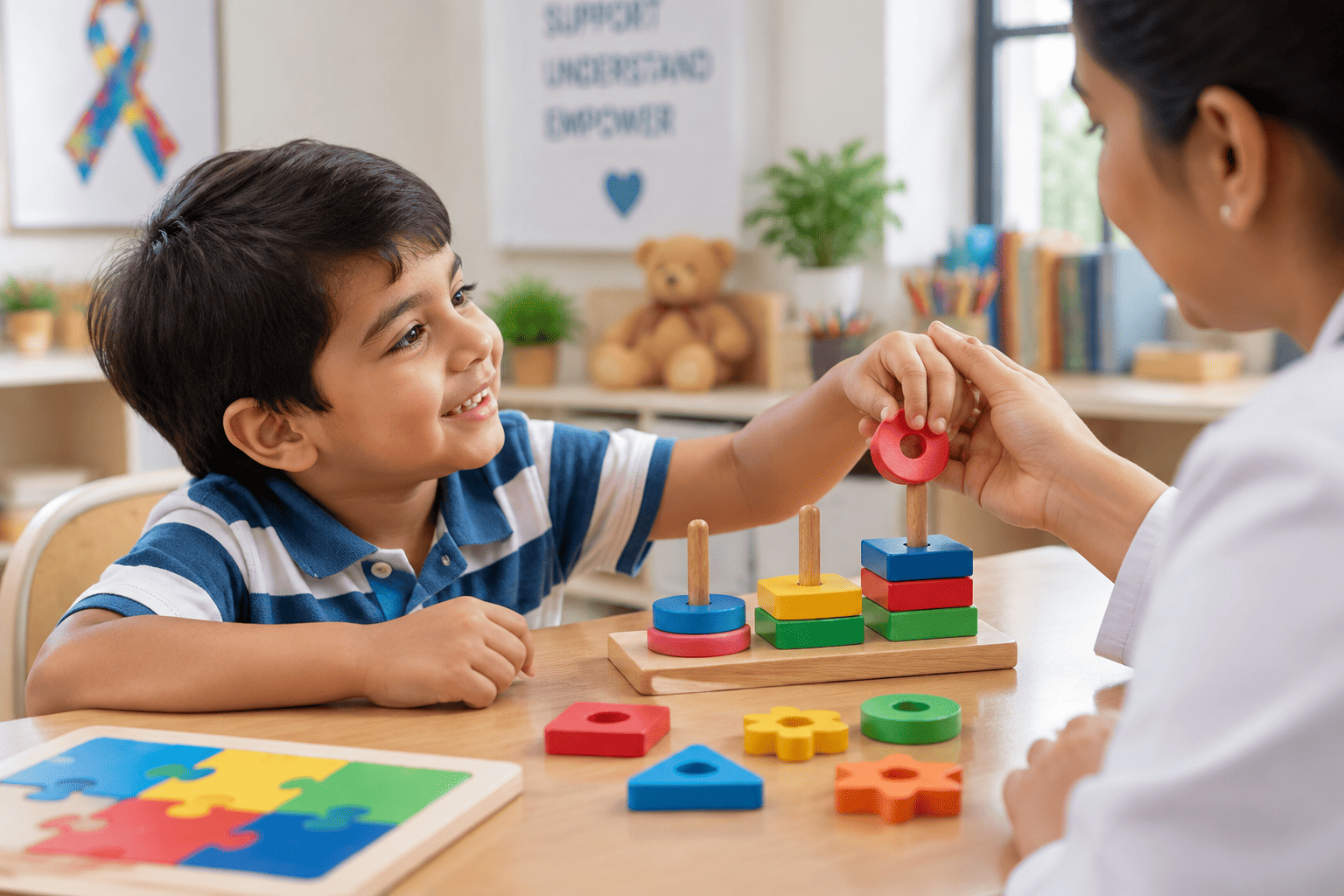
Every child develops at their own pace, but persistent differences in communication, social interaction, behaviour or sensory responses may sometimes indicate Autism Spectrum Disorder (ASD). Recognising developmental concerns early can help families understand their child's needs and access appropriate support.
Autism is a neurodevelopmental condition that affects children differently. Some children may need significant support with communication and everyday activities, while others may have relatively mild difficulties and require support in specific areas.
At Bombay Hospital Jaipur, children with neurological and developmental concerns can receive specialist evaluation and personalised care based on their individual needs.
Autism Spectrum Disorder is a neurodevelopmental condition that can affect social communication, interaction, behaviour and patterns of activities or interests.
The term "spectrum" reflects the wide variation in how autism presents. Two children with autism may have very different strengths, challenges and support requirements.
Autism is not caused by poor parenting, and it is not simply a behavioural problem. It is a developmental condition that requires appropriate assessment and individualised support.
Signs may become noticeable during the early years of childhood. Some common developmental differences include:
A child does not need to display every sign to have autism. Likewise, having one of these behaviours does not necessarily mean that a child has ASD.
Autism can influence different areas of a child's development, including:
Some children may have delayed speech, difficulty starting conversations or challenges understanding non-verbal communication.
A child may find it difficult to understand social cues, share interests with others or participate in age-appropriate social activities.
Repetitive behaviours, strong preferences for routines or difficulty coping with unexpected changes may occur.
Some children may be unusually sensitive or under-responsive to sounds, touch, light, smells or certain textures.
At the same time, children with autism may have important strengths, such as strong memory, attention to detail, creativity or deep knowledge of particular interests.
There is no single cause of Autism Spectrum Disorder. Research indicates that autism is associated with a combination of genetic and developmental factors.
Autism is not caused by vaccines or by parenting style.
Because autism has multiple contributing factors, families should be cautious about claims of a single treatment or intervention that can "cure" autism.
There is no single blood test or scan that can diagnose autism.
Assessment generally involves understanding the child's developmental history and observing communication, social interaction, behaviour and developmental skills.
A specialist may consider:
Information from parents, caregivers and teachers can be valuable because a child's behaviour may vary across different environments.
Additional medical or developmental assessments may be recommended when necessary to identify associated conditions or rule out other concerns.
There is no single treatment that works for every child with autism. Management should be individualised according to the child's strengths, challenges, age and developmental needs.
Support may include a combination of:
Structured developmental and behavioural approaches can help children develop communication, social, learning and everyday skills.
Children with speech or communication difficulties may benefit from speech and language therapy to develop functional communication and interaction skills.
Occupational therapy may help children develop everyday skills and address difficulties related to sensory processing, coordination and participation in daily activities.
Children may benefit from individualised learning strategies and appropriate educational support based on their developmental profile.
Parents and caregivers play a central role in supporting development. Guidance can help families establish routines, encourage communication and understand their child's behaviour.
Early identification does not mean that parents need to wait for every developmental milestone to be missed before seeking help.
When developmental concerns are recognised, appropriate support can begin sooner. Early intervention can focus on communication, social interaction, learning, behaviour and everyday independence.
The goal is not to change a child's personality or make them conform to a particular standard. Instead, support should help children communicate, participate, learn and become as independent as possible.
Autism is primarily diagnosed through developmental and behavioural assessment rather than routine brain imaging. However, children may sometimes have additional neurological or developmental concerns that require further investigation.
Bombay Hospital Jaipur's Neurology department has access to diagnostic facilities including MRI, CT and neurophysiology investigations such as EEG, EMG, NCV, RNS and evoked potentials, when clinically indicated.
A tertiary-care hospital environment can also facilitate coordination with other specialists when a child has associated medical, neurological or developmental needs.
Parents should consider seeking an evaluation if their child:
Developmental regression, particularly loss of previously acquired speech or social skills, should be discussed with a healthcare professional promptly.
Autism is a neurodevelopmental condition and there is currently no proven treatment that simply cures autism. Appropriate developmental, behavioural, communication and educational support can help children develop skills and improve their quality of life.
Signs can sometimes be recognised during the first few years of life. The timing of diagnosis varies depending on the child's development and the complexity of their symptoms.
No. Speech delay can occur for many reasons. A developmental evaluation can help determine whether language delay is occurring alone or alongside other developmental differences.
Not necessarily. Support should be based on the individual child's needs. Some children may benefit from speech therapy, occupational therapy, behavioural support or educational interventions, while others may need different forms of assistance.
Yes. Many children with autism attend mainstream schools, while others may benefit from specialised educational settings or additional classroom support. The appropriate option depends on the child's individual developmental and learning needs.
Do not wait indefinitely for the concern to resolve on its own. Discuss developmental concerns with a qualified healthcare professional who can assess the child and recommend appropriate next steps.
If you have concerns about your child's communication, social interaction, behaviour or developmental progress, an early professional evaluation can provide clarity and help identify appropriate support.
Consult the Neurology team at Bombay Hospital Jaipur for personalised evaluation and management of children with autism spectrum disorder and other developmental or neurological concerns.
 Book an Appointment
 Cardiology
 Cardiovascular Thoracic Surgery
 Endocrinology
 Neurology
 Neuro Surgery
 Nephrology
 Urology
 Gastroenterology
 Pulmonology
  Plastic Surgery
 Nuclear Medicine
  Anesthesiology
  Transfusion Medicine
  Medical Oncology
  Surgical Oncology
  Radiation Oncology
  Critical Care Medicine
  ENT
ENT General Medicine
 General Surgery
 Gynaecology & Obstetrics
 Ophthalmology
 Orthopaedics
 Paediatrics and Neonatology
  Spine Surgery
 Cathlab
 MRI
(3.0 Tesla)
MRI
(3.0 Tesla) CT
Scan (128 Slice)
CT
Scan (128 Slice) 2D Echo
 TMT
TMT PFT
PFT EEG
EEG EMG
& NCS
EMG
& NCS Audiometry
 Flexible Laryngoscopy
 Endoscopy
& Colonoscopy
Endoscopy
& Colonoscopy Bronchoscopy
 Allergy Testing (Skin Prick Test-SPT)
 Microbiology
 Pathology
 Radio-diagnosis
 Radiation Therapy
 Physiotherapy
 Radiology
 Pharmacy
 AKU
Dialysis
AKU
Dialysis  Emergency Service
 Executive
Health Checkup
Executive
Health Checkup