×


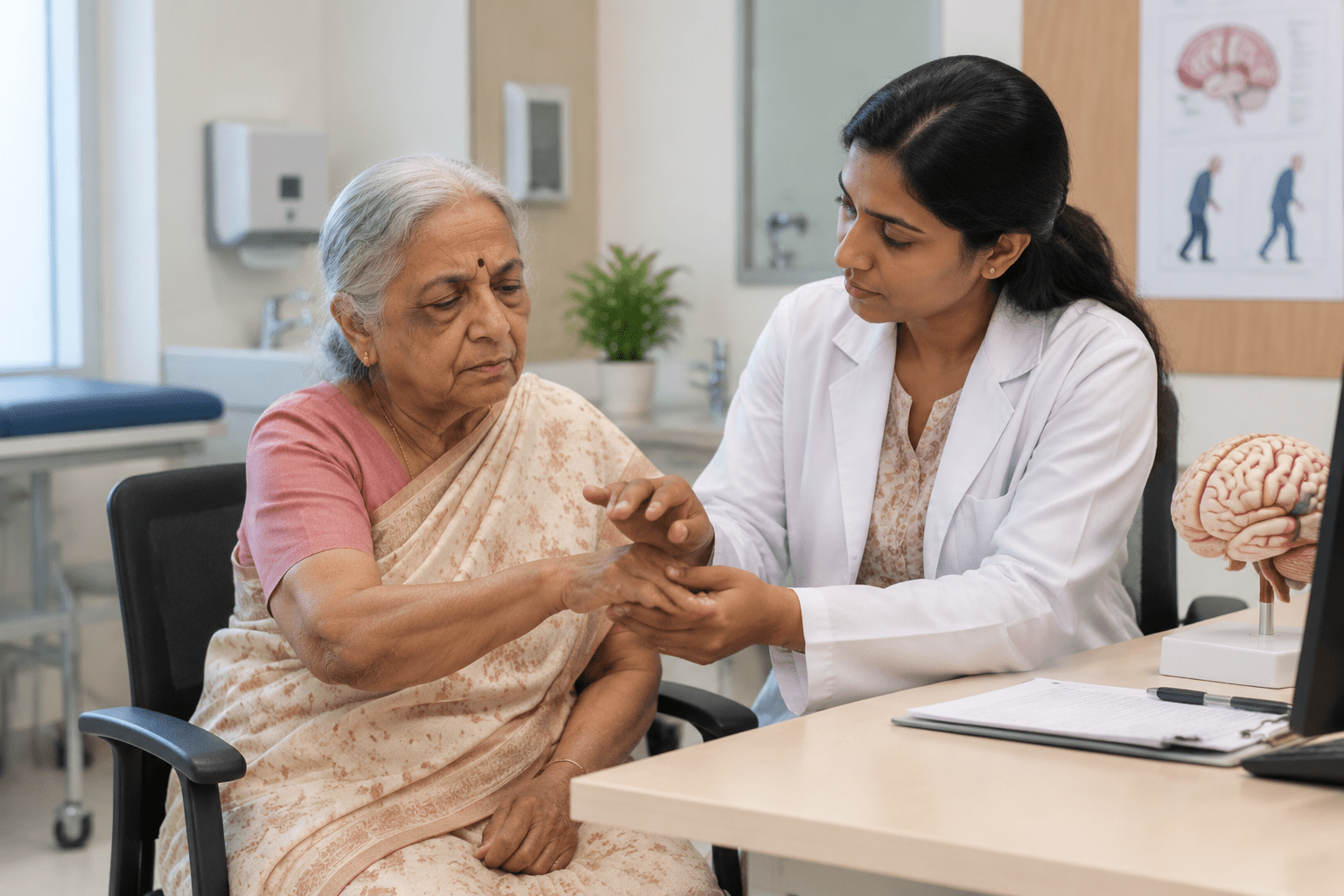
Parkinson’s disease is a progressive neurological disorder that primarily affects movement, but it can also influence sleep, speech, mood, balance and other aspects of daily life. Symptoms can develop gradually and may differ considerably from one person to another.
Early assessment by a neurologist can help identify symptoms, rule out other conditions and develop a personalised long-term management plan.
At Bombay Hospital Jaipur, the Department of Neurology provides diagnosis and treatment for movement disorders, including Parkinson’s disease. The hospital also provides neurological rehabilitation services that can support patients with Parkinson’s disease.
Parkinson’s disease develops when certain nerve cells in the brain become damaged or are lost over time. These cells are involved in producing dopamine, a chemical that plays an important role in coordinating movement.
As dopamine levels decline, patients may gradually develop movement-related symptoms.
Parkinson’s disease is a chronic condition, but appropriate treatment and ongoing care can help many patients manage symptoms and maintain their independence.
Symptoms may initially be subtle and can sometimes be mistaken for normal ageing.
Early signs may include:
Not everyone with these symptoms has Parkinson’s disease. A neurological assessment is important for an accurate diagnosis.
Parkinson’s disease can affect more than movement. Some patients may experience:
Recognising these symptoms allows the neurologist to develop a more comprehensive treatment plan.
The exact cause of Parkinson’s disease is not fully understood. It is believed to involve a combination of genetic and environmental factors.
Age is an important risk factor, although Parkinson’s can also occur in younger individuals.
Having a family member with Parkinson’s disease may increase risk in some people, but most people with Parkinson's do not necessarily have an affected family member.
There is no single test that confirms every case of Parkinson’s disease. Diagnosis is primarily based on the patient's medical history, symptoms and neurological examination.
A neurologist may assess:
Imaging or other investigations may be recommended when required to rule out other neurological conditions.
Bombay Hospital Jaipur's Neurology department has diagnostic support including MRI, CT, EEG, EMG, NCV, RNS and evoked potential testing, depending on the patient's clinical requirements.
There is currently no single treatment that permanently cures Parkinson’s disease. Management focuses on controlling symptoms, maintaining mobility and improving quality of life.
Medicines may be prescribed to improve dopamine-related activity in the brain or address specific symptoms. The choice of medication depends on factors such as age, symptoms, disease stage and response to treatment.
Medication doses may need to be adjusted over time as symptoms change.
Regular physiotherapy can help patients work on:
Exercise and rehabilitation should be tailored to the individual's abilities and medical condition.
Some patients may benefit from speech therapy for changes in voice or swallowing. Occupational therapy can help patients adapt everyday activities and maintain independence.
Because Parkinson’s is progressive, regular neurological follow-up is important. Treatment may need to change as symptoms evolve.
Patients can support their overall wellbeing by:
Family members and caregivers can also play an important role in supporting medication schedules, mobility and everyday activities.
Rehabilitation is an important part of long-term Parkinson’s care. A structured programme can focus on movement, balance, strength and functional independence.
Bombay Hospital Jaipur's physiotherapy services include neurological rehabilitation programmes for conditions such as Parkinson’s disease and stroke, allowing rehabilitation to be incorporated into the patient's overall care plan when clinically appropriate.
Bombay Hospital Jaipur provides neurological evaluation supported by advanced diagnostic facilities and a multidisciplinary approach. The Neurology department works with related specialties and has access to neurophysiology investigations and advanced brain imaging.
This allows patients to receive evaluation, treatment planning, follow-up and rehabilitation support within a tertiary-care hospital environment.
Consider a neurological evaluation if you or a family member develops persistent tremors, unexplained stiffness, slowing of movement, changes in walking, balance difficulties, handwriting changes or other progressive movement-related symptoms.
Early assessment can help determine the cause of symptoms and establish an appropriate management plan.
Currently, there is no definitive cure for Parkinson’s disease. However, medicines, rehabilitation, exercise and regular neurological care can help manage symptoms and maintain quality of life.
No. Tremors can occur because of several neurological and non-neurological conditions. A neurologist should evaluate persistent or unexplained tremors.
Regular, appropriately supervised physical activity can support mobility, strength, flexibility and balance. The exercise programme should be suitable for the patient's condition and abilities.
No. Parkinson’s can also cause non-motor symptoms involving sleep, mood, speech, digestion, cognition and other functions.
Parkinson’s disease is generally progressive, although the rate of progression varies from person to person. Regular follow-up allows treatment and rehabilitation to be adjusted as symptoms change.
Living with Parkinson’s disease requires ongoing care rather than a one-time treatment. With appropriate neurological evaluation, symptom management and rehabilitation, patients can work towards maintaining mobility and independence.
Consult the Neurology team at Bombay Hospital Jaipur for personalised Parkinson’s disease evaluation and long-term management.
 Book an Appointment
 Cardiology
 Cardiovascular Thoracic Surgery
 Endocrinology
 Neurology
 Neuro Surgery
 Nephrology
 Urology
 Gastroenterology
 Pulmonology
  Plastic Surgery
 Nuclear Medicine
  Anesthesiology
  Transfusion Medicine
  Medical Oncology
  Surgical Oncology
  Radiation Oncology
  Critical Care Medicine
  ENT
ENT General Medicine
 General Surgery
 Gynaecology & Obstetrics
 Ophthalmology
 Orthopaedics
 Paediatrics and Neonatology
  Spine Surgery
 Cathlab
 MRI
(3.0 Tesla)
MRI
(3.0 Tesla) CT
Scan (128 Slice)
CT
Scan (128 Slice) 2D Echo
 TMT
TMT PFT
PFT EEG
EEG EMG
& NCS
EMG
& NCS Audiometry
 Flexible Laryngoscopy
 Endoscopy
& Colonoscopy
Endoscopy
& Colonoscopy Bronchoscopy
 Allergy Testing (Skin Prick Test-SPT)
 Microbiology
 Pathology
 Radio-diagnosis
 Radiation Therapy
 Physiotherapy
 Radiology
 Pharmacy
 AKU
Dialysis
AKU
Dialysis  Emergency Service
 Executive
Health Checkup
Executive
Health Checkup